If you have opened this article, chances are that you have consumed a lot of productivity content through the internet. You’ve tried the 25-minute tomato timer techniques, you’ve built the calendar that looks like a toddler’s playschool coloring project, you’ve learned the ancient Japanese techniques that teach you how to keep track of the time you’ve spent on the toilet pooping. And many more such pieces of productivity advice that somehow never seems to solve your procrastination.
In this article, I’ll explain the current landscape of the productivity genre on the internet, why a lot of the productivity advice fails to fulfill its promise, and finally, what will actually solve your productivity problems.
The productivity genre on the internet
In recent times productivity has emerged to be one of the fastest growing sub-genre’s of the self-improvement space on the internet. Although it was started with noble intentions to help busy people manage their time, and live a more fulfilling life by spending more time on what actually matters to them, it has quickly evolved into nothing more than a joke. In which you do x technique prescribed by Influencer Y to hyper-optimize every second of your life. You achieve undeniable success.
What corrupted the productivity space on the internet?
Money. That’s it.
Productivity advice used to be about how you can more resourcefully use the limited 24-hours you get, but it has evolved into a genre with a leather-bound notebook and Japanese stationery fetish, why? Affiliate commissions.
Most productivity influencers instead of actually wanting to help you solve your productivity problems are trying to sell you something that feels like an instant solution. Either it is a Become so productive in 30-days that it scares people course for $19.99 or an app that reduces your procrastination habit or a new journaling technique for which you require a fancy leather-bound journal with a $50 fountain pen. Or countless online templates that will solve 100% of your productivity problems.
Are they a scam? No. Do they cause any harm? No. Then what’s the issue?
Why is most productivity advice on the internet bad advice?
Although there is nothing wrong with earning money from the internet through affiliate commissions or course/product sales (I do it myself), the concern with all of these is that they do not fundamentally attack the real reason people feel unproductive. Instead, they foster something which is commonly called consumerism.
All the calendar techniques, the journaling, the apps, the courses are just tools for productivity. They are presented or sold with the narrative to solve all your productivity problems, but there is a deeper underlying issue that needs to be solved to be more productive. This is a concern none of these tools are even trying to address. Instead, they are making you sink deeper down the consumer rabbit hole, while you are narcissistically thinking you are improving your life.
Considering productivity tools will solve your procrastination is equivalent to thinking Jimmy Page is a great guitar player because of the set of strings or the guitar pick he uses. In reality, he has evolved into a great guitar player because he approached guitar playing from the fundamentals, i.e. understanding music theory, the feel behind every note he plays, and having a great sense of rhythm to make his guitar playing sound surreal.
I am not against all these productivity tools and techniques, but I intend to convey that you must approach productivity fundamentally first, by understanding the real reason behind your sloth, and then go on to use these productivity tools. If you do so, it is most likely that you will channelize your energy in a better manner, and make a better use of your limited time.
The more profound problem behind procrastination
The biggest reason you are procrastinating is the suppression of your feelings. The reason is not logical but emotional.
Feelings? Emotions? Really?
Yeah, the real reason you aren’t concerned about something and delay it until it causes you a panic attack, and makes you consume 20 cans of Red Bulls to work on it at the last minute, is your emotions.
Fundamentally there are only a few emotions behind your inaction, by understanding these underlying emotions you address the actual factors behind procrastinating.
These emotions in my opinion are mainly of two categories which are:
- Fear-based emotions
- Meaning-based emotions
Fear-based emotions
The far easier emotions to understand behind procrastination is fear.
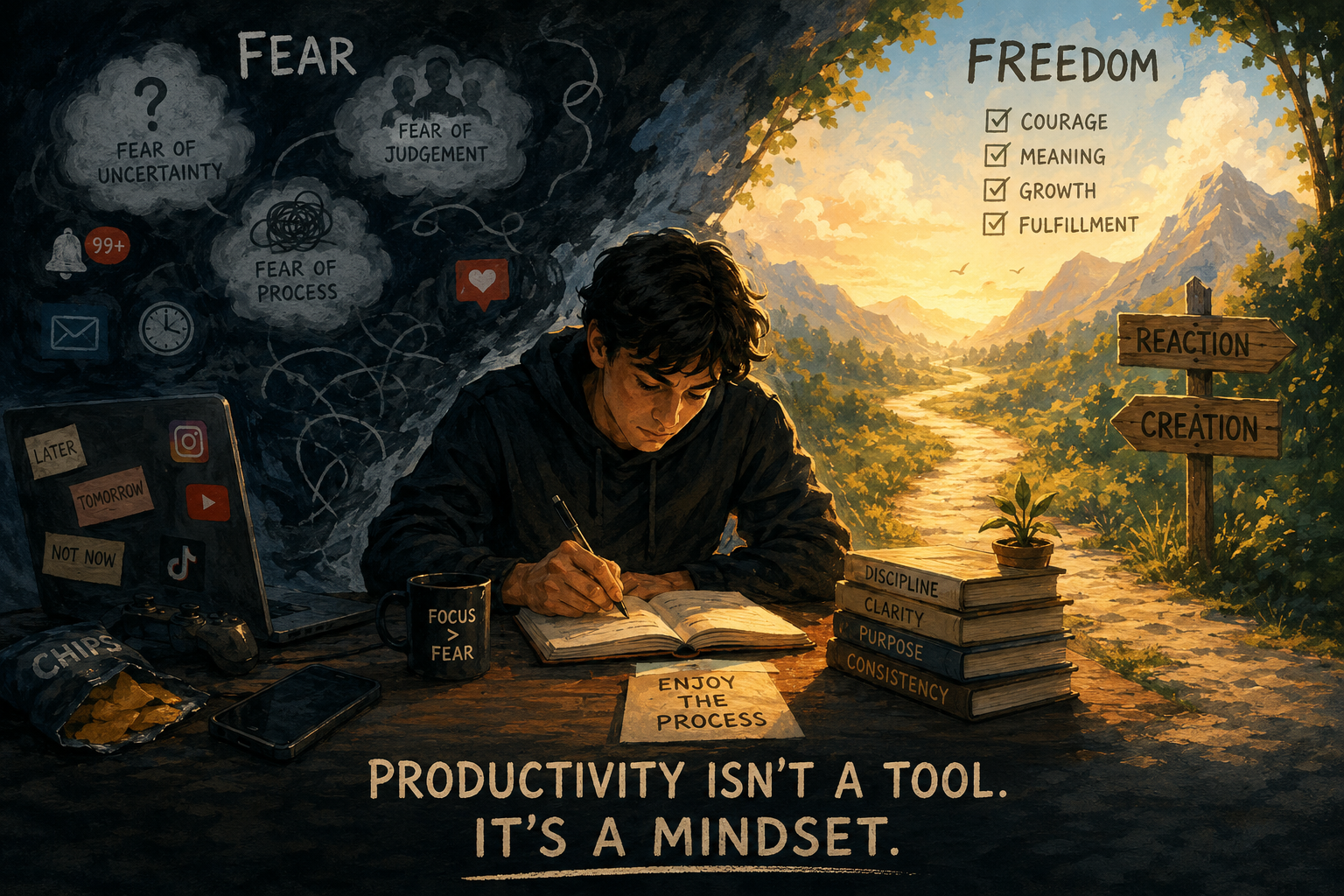
There are only a few ways fear can make you feel unproductive, which are:
Fear of uncertainty:
Here the fear of the uncertain outcomes despite making efforts has paralyzed you to start trying in the first place. You are too scared to try because you are scared that you will fail.
Fear of judgment:
Here you have developed a fear because of other people’s expectations and opinions. You are too afraid to start something as you are afraid the result may either not satisfy your peers or may cause harm to your reputation.
Fear of process
Here before starting anything you have overanalyzed the process of getting a task completed, and ultimately have decided that this task would require you to spend far too much of your mental capacity to understand and complete, so instead of spending anytime on the task, you ignore it altogether.
Overcoming these emotions
Now you may wonder how to overcome these fears and ultimately become productive?
The solution is simple. Enjoying the process.
Sounds simple? It probably isn’t as easy as it sounds, but it’s not that hard either. Enjoying the process ultimately refers to finding joy in the smallest things that are happening right now while you are working on something, not fantasizing about the great successes or the terrible failures that may occur in the future. It’s what James Clear calls the System First Approach.
Everyone has a different way of finding joy in what they are doing, but in essence it is breaking down a task into smaller bits so that it doesn’t cause too much of a cognitive load, and making each bit more enjoyable through certain tools and techniques.
It is here is where all those tools and techniques offered by productivity gurus help you, here you understand which tool actually makes the process more enjoyable for you, this varies for every person; therefore I’m making the argument, understand your emotions first, then focus on the tools, not vice versa.
Experimenting with different tools is the only way you can discover what makes work more enjoyable for you and what doesn’t. For instance, some people love tools like to-do lists and timers as it gamifies the process for them, and makes it more fun for them, whereas for some people these tools increase their anxiety ultimately making their progress to stall completely.
Meaning-based emotions
These emotions or feelings are far more difficult to overcome and have much more severe consequences than fear-based emotions, these are much more difficult to overcome to solve inaction.
Meaning-based emotions are those emotions which make you procrastinate because you there is no ‘strong why’ for you to complete that task. There is an emptiness that is experienced while engaging in the process.
Meaning-based procrastination is far more challenging to overcome as it is far more difficult to acknowledge the fact that you find a task meaningless because your intellect continually tries to convince you that the task at hand is vital, but intrinsically your feelings disagree.
Here, your contrasting thinking and feelings are continually juxtaposed and that juxtaposition gradually builds up large feelings of existential dread within you, which ultimately results in a never-ending cycle of procrastination.
The reason I consider the consequences for more severe here is because here your rational mind is constantly pushing you towards action and your feelings are pulling you towards inaction, the result of this tug-of-war between your feelings and thinking is that the feelings always emerge victorious, our feelings are always controlling us, our thinking can just suggest our feelings not vice versa, our actions are our emotions, but because your thinking is now the loser of this tug-of-war a constant sense of guilt and shame starts emerging within you, this leads to a spiral of even more existential dread which ultimately can lead to self harm.
What to do?
The superficial answer here is again make the process fun, but it is not easy here at all, the only way you can overcome your existential dread that is causing you to procrastinate is learning to accept your emotions instead of being at odds with your thinking constantly.
Really?
Yes, acknowledge that you find something meaningless, and convey that to your rational thinking instead of denying it because your thinking proposes so, this first step brings both your thinking and feeling in the same direction. Next, look at the task, and break it down as far as you can, now from this try and understand which bits give you positive feelings, which bits give you negative feelings and which are the bits that you are neutral.
So, do I quickly do the positive aspects, somehow complete the neutral bits and avoid the negative?
No you dummy, don’t rush. Avoidance should only be the last resort, go action first, stack all the bits up, mix it up somewhat like POSITIVE → NEGATIVE → NEUTRAL → POSITIVE → NEUTRAL → NEGATIVE → POSITIVE…, the process of looking forward towards a bit that makes you feel positive will bring more meaning into the tasks that make you feel negative.
But I don’t find anything positive in what I do?
If your existential dread has reached to a level of where your whole cognition is under total dysfunction, avoid a task only then, it is most likely that your existential dread is resulting from a very traumatic episode.
The word trauma get’s thrown around like it’s a pair of dice, but in reality trauma is something that make you so dysfunctional, that you cannot function for even a second with your existence. It’s something which you may never come out of, but only can manage to live with. Here both your thinking and feelings have stalled due to some event, they aren’t pulling in opposite directions but have been completely dysfunctional. The trauma is so significant that bot your thinking and feeling both cannot get past it.
At this stage, it is best to seek help from a therapist, the task can wait, this is only time you should avoid doing the task. Nothing is going to work until you get your feelings and thinking back into action. People who have experienced trauma may never overcome it, with therapy their thinking and feelings comeback to a somewhat functional state where they can consciously derive meaning in what they are doing.
Thanks for reading this article, if you have some feedback or any suggestions, please email me at [email protected].
None of this is professional advice.